
A blank sheet of paper can turn into a Christmas keepsake in less than 10 minutes. That is the charm of christmas tree coloring pages: they give kids a simple holiday activity while leaving plenty of room for their own colors, decorations, and imagination.
Some designs work best for preschoolers with chunky crayons, while others offer intricate branches, ornaments, and cozy holiday scenes for older kids and adults. Whether you need a quick classroom activity, a quiet afternoon project, or handmade Christmas decor, these 21 ideas give you plenty of festive ways to start.
Quick Answer
The best christmas tree coloring pages include simple trees for preschoolers, decorated trees with ornaments and gifts, Santa-and-tree scenes, snowy outdoor designs, blank templates, animal-themed trees, and detailed pages for older colorists. Print them on US Letter or A4 paper and choose crayons, colored pencils, or markers based on the design.
1. Simple Christmas Tree With a Star
Start with a classic three-tiered tree and one large star at the top. This design works especially well for ages 3–5 because the broad sections are easy to fill without requiring tiny movements or detailed shading.
Use three shades at most: green for the branches, yellow for the star, and red for a few ornaments. A page like this can usually become a 5–10 minute activity for a preschooler.
2. Cute Christmas Tree With Big Ornaments
A friendly tree with oversized baubles makes a cheerful option for young children who are still learning to stay inside outlines. The larger shapes also make cute christmas tree coloring pages easier to complete with crayons.
Try giving the child five crayons and letting them choose a different color for each ornament. This creates a simple color-recognition activity without turning the project into a formal worksheet.
3. Decorated Tree With Gifts
Add wrapped presents underneath a fully decorated tree for a page that feels more like a complete Christmas scene. Include 4–6 gift boxes with different ribbon patterns so children have several small areas to personalize.
Red, green, gold, and blue create a traditional palette, but there is no need to follow a fixed scheme. Let children decide whether every present should match or look different.
4. Easy Christmas Tree for Preschoolers
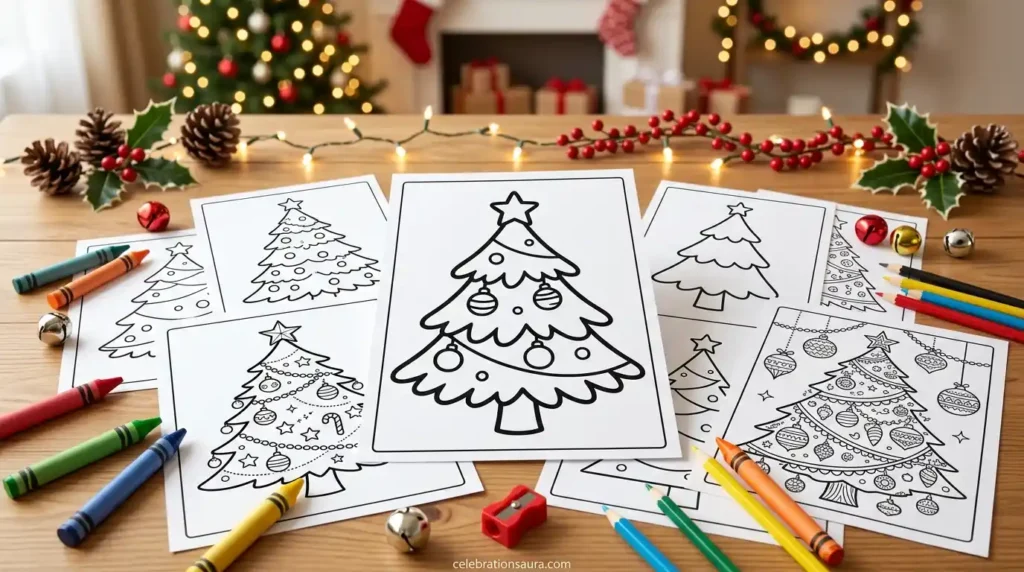
For ages 3–5, choose a tree with thick outlines, large branches, and only a few decorations. Preschool christmas tree coloring pages should leave enough open space for chunky crayons instead of filling the sheet with tiny ornaments.
A 5–10 minute coloring session is usually enough for a first attempt. If the child finishes quickly, ask them to draw one extra ornament, present, or star rather than immediately moving to a harder page.
5. Blank Tree to Decorate Yourself
A blank tree outline gives children control over the entire design. Instead of providing ornaments, leave 15–20 open spaces where they can draw circles, stars, candy canes, bows, or other decorations.
This option also works well as a classroom craft. Print the tree on cardstock, let each child decorate it, then display the finished designs on a bulletin board or classroom window.
6. Santa and Christmas Tree Coloring Page
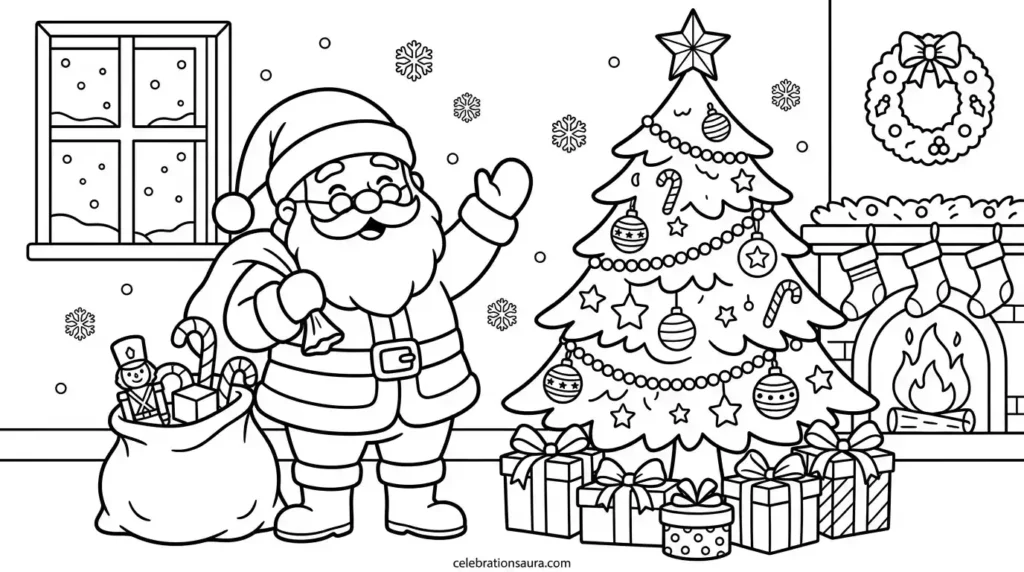
Combine Santa with a decorated tree for a scene that immediately feels connected to Christmas morning. A Santa figure can stand beside the tree, peek around it, or place gifts underneath it.
Santa and christmas tree coloring pages are particularly useful when children enjoy storytelling. After coloring, ask them what Santa is doing, where the gifts came from, and what might happen next.
7. Christmas Tree With Ornaments and Garlands
Give older kids a little more detail with layered garlands, baubles, ribbons, and a star topper. Around 12–20 individual decorative areas provide enough variety without making the page feel overwhelming.
Use colored pencils for smaller ornaments and markers for larger branches. A limited palette of four or five colors can make the finished tree look coordinated rather than overly busy.
8. Snowy Christmas Tree in the Forest
Move the activity outdoors with a Christmas tree surrounded by snow, pine trees, snowflakes, or small woodland details. This design is different from a living-room tree because the background becomes part of the coloring experience.
Use pale blue and gray for snow shadows, then add dark green to the evergreen branches. For a 15–20 minute activity, encourage children to color the sky and ground after finishing the tree.
9. Christmas Tree by a Fireplace
A fireplace scene adds stockings, presents, candles, or a cozy room around the tree. It works especially well for older kids because there are more objects to identify and color.
You can turn the page into a storytelling prompt by asking children to choose who lives in the room and what happened before Christmas morning. The finished picture can then become part of a homemade holiday display.
10. Christmas Tree With Cats or Other Animals
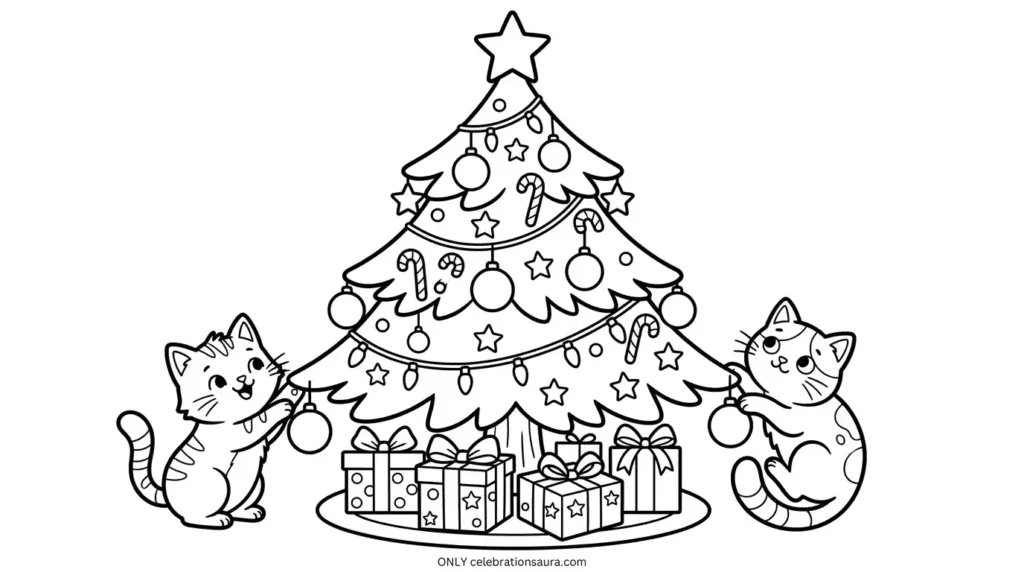
Animal-themed designs give traditional trees a playful twist. A cat tangled in lights, a dog sitting beside presents, or woodland animals decorating a tree can make the scene feel more like a short story.
This is one of the better choices for children who lose interest in a plain tree. Give them 20 minutes and encourage them to assign colors to both the tree decorations and the animals.
11. Small Christmas Tree Coloring Pages
A smaller tree with fewer decorations is useful when you need a quick activity or a compact craft. These small christmas tree coloring pages can fit easily into a Christmas card, gift tag project, or classroom activity.
Print the design at a smaller scale or cut the finished tree from the page. Add a short handwritten message underneath and turn it into a simple holiday keepsake.
12. Cute Tree With Presents and a Smiling Face
Give the tree a personality with eyes, a smile, oversized ornaments, and two or three presents. The friendly character makes the design approachable for toddlers and younger preschoolers.
Keep the palette simple with three or four crayons. For example, use green for the tree, red for the presents, yellow for the star, and blue for selected ornaments.
13. Christmas Tree With Lights
A tree covered in string lights creates an excellent opportunity to practice repeated color patterns. Use 10–15 light bulbs and create a simple sequence such as red, yellow, blue, red, yellow, blue.
This also makes the page useful for a small educational activity. Younger children can count the lights, name the colors, and circle their favorite bulb before finishing the rest of the tree.
14. Detailed Christmas Tree for Older Kids
Older children, tweens, teens, and adults may prefer branches filled with small ornaments, ribbons, pinecones, lights, and patterned decorations. These designs can easily turn into a 30–45 minute quiet activity.
Colored pencils are a good choice because they allow controlled shading around small shapes. Add two shades of green to the branches and a metallic-looking yellow or gold pencil to the star.
15. Christmas Tree Mandala or Pattern Design
A patterned tree replaces ordinary ornaments with repeated shapes, swirls, stars, dots, and symmetrical decorations. It is a stronger choice when the goal is a longer, more detailed coloring session.
Choose 5–7 colors and repeat them throughout the pattern. Keeping the palette consistent makes a complicated design easier to manage and gives the finished page a more intentional look.
16. Santa’s Workshop Christmas Tree
Turn the tree into part of a larger holiday story by placing it inside Santa’s workshop. Add toy boxes, ribbons, elves, tools, or wrapped presents around the main tree.
This idea works particularly well for children who enjoy imaginative play. Give them 20–30 minutes and ask them to invent a name for the workshop and decide which present should be delivered first.
17. Christmas Tree With a Snow Globe
A tree inside a snow globe creates a compact winter scene with snowflakes, a base, and a decorated evergreen. The circular border gives children an easy area to decorate after completing the tree.
Use light blue for the globe, white spaces for falling snow, and two or three strong colors for the tree. Once finished, cut around the outer shape and use it as holiday wall decor.
18. Christmas Tree Farm Scene
Instead of coloring only one decorated tree, show several evergreens at a Christmas tree farm. Add a small pickup truck, snow, a fence, or a child choosing a tree to create a more detailed setting.
This design can introduce a real-world Christmas tradition while remaining fun. Use different greens for the trees so the background does not look like one large block of color.
19. Printable Christmas Tree Coloring Pages for Holiday Cards
Turn the finished artwork into something useful by printing a tree with enough white space around it for a message. Printable christmas tree coloring pages can become homemade cards once the coloring is finished.
Print on cardstock rather than ordinary copy paper if the finished page will become a card. A 65–80 lb cardstock sheet gives the project more structure and handles colored pencils or light markers better.
20. Christmas Tree Coloring Pages Easy Enough for Beginners
Beginners do not need an elaborate scene to make a beautiful finished page. Look for broad branches, thick outlines, fewer than 10 ornaments, and a clear star or topper.
Christmas tree coloring pages easy enough for beginners can usually be completed in about 5–15 minutes. Start with crayons, then move to colored pencils when the child wants more control over small details.
21. Creative Christmas Tree With an Unusual Theme
Once the classic designs are covered, try something unexpected: a cupcake tree, space-themed tree, toy-filled tree, robot tree, or whimsical animal tree. Current coloring-page collections are increasingly using these playful variations alongside traditional designs.
These designs are especially useful for children who have already colored several traditional trees. Give them 20–30 minutes and encourage them to invent a completely new decoration that matches the theme.
Which Christmas Tree Page Should You Choose?
| Best choice | Ideal for | Typical time | Best tools |
|---|---|---|---|
| Simple tree | Ages 3–5 | 5–10 min | Chunky crayons |
| Decorated tree | Ages 5–8 | 10–20 min | Crayons or pencils |
| Santa scene | Story-loving kids | 15–25 min | Crayons or markers |
| Snowy scene | Ages 6+ | 15–25 min | Pencils |
| Detailed tree | Tweens, teens, adults | 30–45 min | Colored pencils |
| Blank template | DIY crafts | 15–30 min | Markers, pencils |
If you are planning a classroom activity, simple trees and blank templates are the easiest to prepare in quantity. For a family evening, choose decorated, snowy, or fireplace scenes that give everyone more objects to discuss.
For a larger holiday activity, you can also pair the finished pages with [Christmas party games for adults] or display them alongside [Christmas decoration ideas] for a handmade seasonal touch.
How Do You Print Christmas Tree Coloring Pages?
Download the highest-resolution PDF or PNG available, then print on US Letter or A4 paper. For most home printers, Fit to printable area is a safe setting when the page needs to stay inside the margins.
For crayons, standard printer paper is usually enough. If children will use markers, 90–120 gsm paper or cardstock can reduce bleed-through and make the finished artwork easier to display. Current printable collections commonly support US Letter and A4 formats.
A simple printing routine is:
- Choose the design and open the full-size file.
- Select US Letter or A4 paper.
- Use portrait orientation when the tree is vertically arranged.
- Choose Fit to printable area or 100% according to the file instructions.
- Print one test sheet before making a large classroom batch.
Are Free Christmas Tree Coloring Pages Really Useful for a Party?
Yes, because they need very little preparation and can occupy children for roughly 10–30 minutes depending on complexity. Print 2–3 designs per child and place crayons, pencils, or washable markers at a separate activity table.
For a Christmas party, add a small display area where children can tape their finished trees. You can also turn completed sheets into place cards, cards, paper ornaments, or a simple holiday banner.
What Colors Should You Use for a Christmas Tree?
Traditional choices include green branches, red ornaments, yellow or gold stars, and white or silver lights. However, a coloring page does not need to copy a real Christmas tree, so children can use pink, purple, turquoise, orange, or any combination they like.
For a polished adult-style page, choose 4–6 colors and repeat them throughout the design. For preschoolers, focus on naming colors rather than creating a perfectly coordinated palette.
How Can You Make Coloring More Fun?
Give the activity a small challenge instead of simply handing over the page. Ask the child to use exactly five colors, create a repeating ornament pattern, or draw one new decoration after finishing the original design.
You can also turn the completed sheet into a craft. Cut out the tree, glue it onto cardstock, punch a small hole at the top, and add 6–8 inches of ribbon to make a simple holiday ornament.
What Should Preschoolers and Older Kids Use?
Preschoolers generally benefit from large shapes and bold outlines, while older kids can handle smaller ornaments and more detailed backgrounds. Current collections commonly divide designs into easy preschool pages, medium-detail children’s sheets, and intricate pages for older colorists.
For ages 3–5, start with a simple tree and 5–10 minute session. For ages 6–9, introduce decorated trees and scenes with 10–20 details. Older children can move toward patterned or realistic designs that take 30 minutes or more.
Common Mistakes to Avoid
The biggest mistake is choosing a page based only on how attractive it looks. A highly detailed tree may frustrate a three-year-old, while a very simple outline may bore an older child after five minutes.
Another mistake is printing dozens of pages before testing one. Print a single sheet first and check the margins, line quality, paper size, and whether your chosen markers bleed through.
Can You Use These Pages for Crafts?
Yes. Finished sheets can become cards, gift tags, paper garlands, window decorations, placemats, or small ornaments. One practical option is to color several trees, cut them out, and string 6–10 of them across a mantel or classroom wall.
For a reusable project, laminate the finished page or place it inside a clear sleeve. This lets children use dry-erase markers to recolor a simple design several times during December.
Final Thoughts
Christmas tree coloring pages can be much more than a quick sheet to keep kids occupied. A simple tree can give a preschooler a five-minute confidence boost, while a detailed evergreen can become a relaxing 30-minute project for an older child or adult. The best choice depends on the person’s age, attention span, preferred coloring tools, and the amount of detail they enjoy.
For a family activity, print three different styles and let everyone choose one. For a classroom, simple outlines and blank templates are easy to prepare in larger quantities. And if you want the finished artwork to become part of your holiday decor, use cardstock and turn the best designs into cards, ornaments, or a paper garland. Pick a favorite design, grab the crayons, and make your own Christmas tree masterpiece.
FAQs
Many collections are free to download or print, but usage rights vary by website. Some allow personal and classroom use while restricting redistribution or commercial use, so check the individual site’s terms before sharing files publicly.
They can work from about age 3 through adulthood when the design matches the colorist’s ability. Choose thick outlines and large spaces for preschoolers, medium detail for elementary children, and intricate patterns for older kids and adults.
Standard printer paper works well for crayons and colored pencils, while heavier paper or cardstock is better for markers and crafts. If you plan to cut out the finished tree, cardstock around 65–80 lb provides more structure.
Yes, if the file can be imported into a compatible coloring or drawing app. PNG files are particularly convenient for digital coloring because they can be opened on a tablet or computer and colored without printing.
Choose a simple tree with thick outlines, large decorations, and no crowded background. A 5–10 minute page is a practical starting point, followed by a second design if the child wants more coloring time.
Discover More
elegant christmas party dresses: 20+ Stylish Ideas for Every Celebration
Christmas Bathroom Decor: Festive Ideas for Every Bathroom
Christmas Party Decorations: 25 Creative Ideas for a Festive Celebration
20+ Easy Pipe Cleaner Christmas Tree Ideas That Look Amazing
