
Tiny Tim is one of the most memorable characters in Charles Dickens’s A Christmas Carol. Although he appears in only a few important scenes, his kindness, hope, and love for his family give the Christmas story much of its emotional power.
Tiny Tim also helps Scrooge understand something he once ignored: poverty affects real people and real families. When Scrooge sees what could happen to the young Cratchit boy, he begins to question his selfish way of life. For anyone searching for Tiny Tim A Christmas Carol, this guide explains who he is, what he represents, his famous quote, his relationship with Scrooge, and what happens to him at the end.
Who Is Tiny Tim in A Christmas Carol?
Tiny Tim is the youngest son of Bob Cratchit, Ebenezer Scrooge’s clerk. The Cratchit family has very little money, but they still celebrate Christmas with warmth and gratitude. Tim has a physical disability and uses a crutch, yet Dickens does not define him only by his health.
Instead, readers see a cheerful, loving, and thoughtful child who enjoys being with his family. His character creates an important contrast with Scrooge. Scrooge has money but lives without close family connections. Tim has very little but enjoys love, companionship, and a strong sense of Christmas spirit. That contrast becomes one of the most important parts of Scrooge’s transformation.
What Happens to Tiny Tim in A Christmas Carol?
Tiny Tim faces a frightening future because of his poor health and the Cratchit family’s financial situation. When the Ghost of Christmas Present visits Scrooge, the Spirit shows him the Cratchit family’s Christmas celebration. Scrooge notices Tim’s physical weakness and learns that the boy may not survive if his circumstances remain unchanged.
Later, the Ghost of Christmas Yet to Come shows Scrooge a future in which Tiny Tim has died. The vision deeply troubles Scrooge. He finally understands that his choices can affect the lives of people who have done nothing to deserve hardship. After Scrooge changes his behavior, that frightening future no longer happens.
Tiny Tim survives.
Does Tiny Tim Die at the End?
No. Tiny Tim does not die at the end of Dickens’s story.
Scrooge sees Tim’s death as part of a possible future. The vision shows Scrooge what may happen if he continues living selfishly.
When Scrooge wakes on Christmas morning, he decides to change. He becomes generous toward the Cratchit family and helps create better circumstances for them. Dickens later tells readers that Tiny Tim survives. This ending gives the story its hopeful Christmas message: people can change their actions, and those actions can change the future.
Why Is Tiny Tim Important in A Christmas Carol?
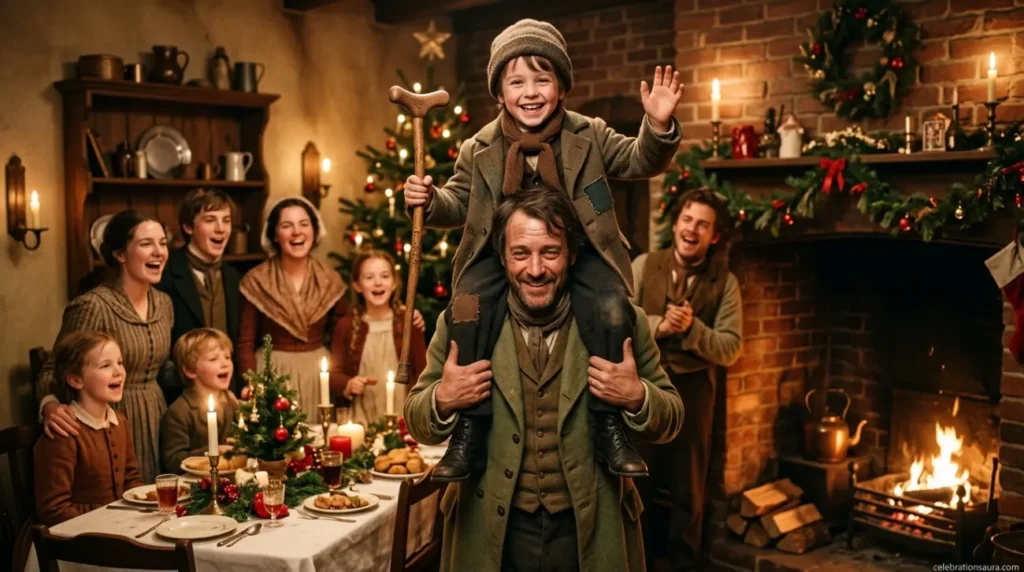
Tiny Tim gives Scrooge a personal reason to care about poverty.
At the beginning of the novella, Scrooge treats poor people as a problem rather than as individuals. He shows little sympathy for people who need help.
Tim changes that perspective.
Scrooge sees a child who struggles with his health but still enjoys Christmas and loves his family. When Scrooge discovers that Tim could die, poverty becomes personal rather than abstract.
Tim’s story therefore helps Dickens show why compassion matters.
The child does not change Scrooge by giving a speech about morality. Instead, his situation makes Scrooge feel the consequences of his own indifference.
Tiny Tim Character Analysis
A Tiny Tim character analysis becomes easier when you focus on his main qualities.
Kindness
Tim treats other people with warmth and goodwill. His famous Christmas blessing shows how naturally kindness comes to him.
Hope
Even though Tim faces serious difficulties, he remains hopeful. His attitude creates a sharp contrast with Scrooge’s bitterness.
Innocence
Tim represents childhood innocence. Dickens uses his vulnerability to make readers care about the consequences of poverty.
Family Love
Tim shares a close relationship with Bob Cratchit and the rest of his family. Their Christmas celebration shows that love can exist even when money is limited.
Faith
Tim’s comments about church and healing connect him with the religious themes of Dickens’s Christmas story.
Together, these qualities make Tim much more than a symbol of weakness. He becomes a symbol of the goodness that Scrooge has lost and eventually begins to recover.
What Does Tiny Tim Represent?
Tiny Tim represents innocence, compassion, hope, and the human cost of poverty.
Dickens could have discussed poverty through statistics or political arguments, but he instead gives readers a child.
That choice makes the issue emotional and personal.
When readers see Tim enjoying Christmas with his family despite hardship, they understand what poverty can put at risk. His possible death also shows that financial hardship can affect a family’s health and future.
Tim therefore represents people who need compassion and support, especially those who cannot easily change their circumstances themselves.
What Does Tiny Tim Symbolize?
The symbolism of Tiny Tim connects closely with the main themes of A Christmas Carol.
Tiny Tim’s physical vulnerability represents the dangers faced by people living in difficult circumstances. His kindness reflects the generosity that Scrooge initially lacks. Through his famous Christmas blessing, Dickens highlights goodwill toward everyone. Tim’s survival ultimately represents hope and the possibility of positive change.
This symbolism becomes especially powerful because Tim remains hopeful despite his difficulties.
Why Does Tiny Tim Say “God Bless Us Every One”?
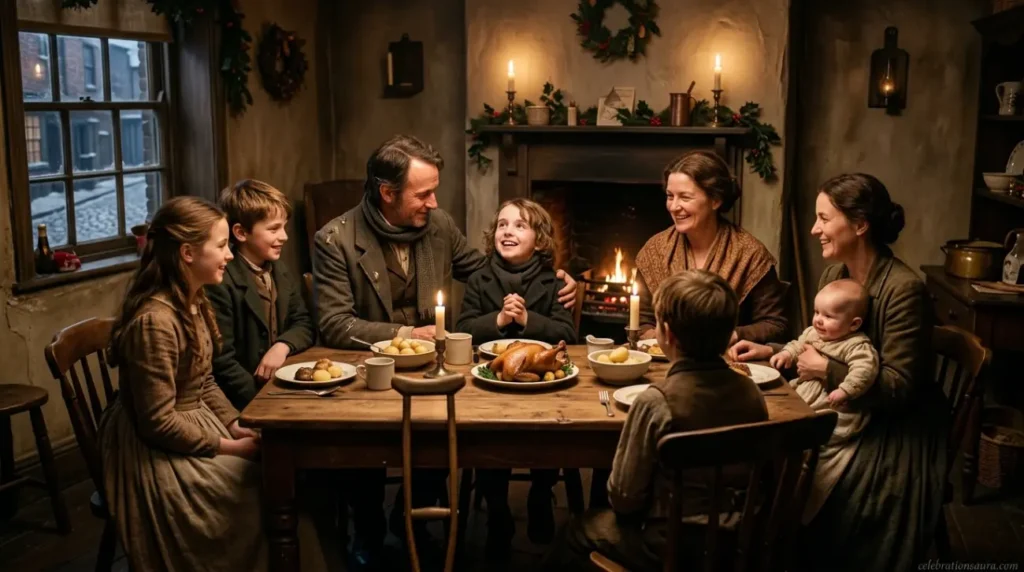
Tiny Tim’s most famous words are:
“God bless us every one!”
Tim says this during the Cratchit family’s Christmas celebration. The quote captures the heart of his character. He does not wish blessings only for himself or his family. He includes everyone.
That small phrase also fits Dickens’s larger Christmas message. The story encourages people to look beyond themselves and care about the people around them.For a Tiny Tim A Christmas Carol quote search, this is the most important line to remember.
What Are the Best Tiny Tim Quotes?
The most famous Tiny Tim quote is:
“God bless us every one!”
This line works particularly well for a character analysis because it shows Tim’s generosity and optimism in only a few words. Another important moment comes when Tim expresses hope that people who see him at church will remember the story of Christ healing those who were sick. Together, these moments show why Dickens connects Tim with faith, compassion, and Christmas goodwill.
How Does Tiny Tim Affect Scrooge?
Tiny Tim helps Scrooge experience empathy. Before the spirits visit him, Scrooge has little interest in other people’s suffering. He cares strongly about money and very little about community.
Tim changes that emotional distance.
When Scrooge sees the Cratchit family together, he notices the love they share despite their limited resources. When he later sees the possibility of Tim’s death, he becomes frightened by the consequences of his own selfishness. Tim therefore becomes an important part of Scrooge’s moral awakening. Scrooge’s transformation is not only about becoming nicer. It is about recognizing that his decisions can affect other people’s lives.
What Does Tiny Tim’s Relationship With Bob Cratchit Show?
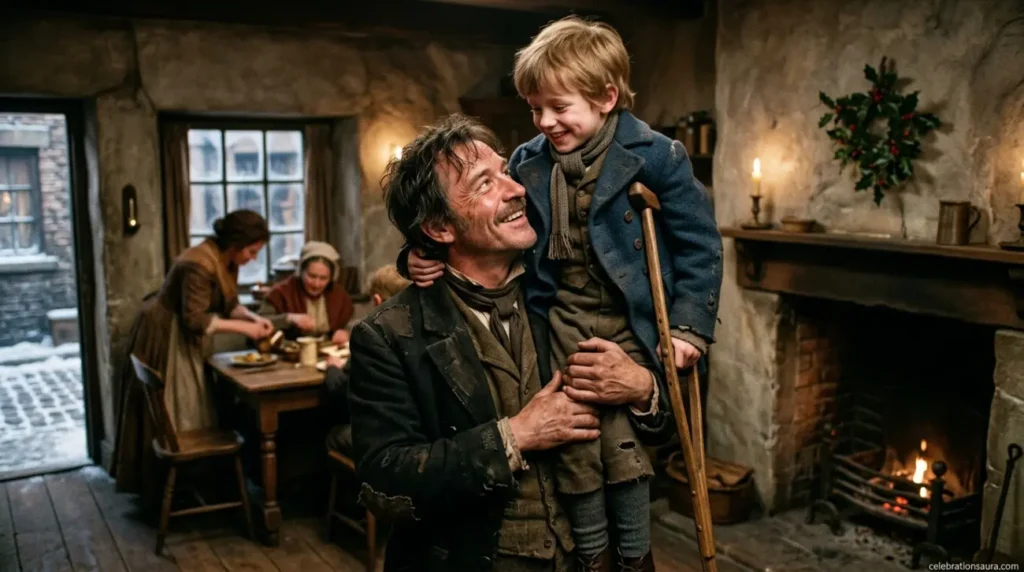
Tiny Tim’s relationship with Bob Cratchit shows the strength of parental love. Bob cares deeply for his son and protects him despite the family’s financial difficulties. The Cratchit family also makes Tim part of their Christmas celebration.
Their relationship gives the story emotional warmth. It also makes Scrooge’s treatment of Bob more important. Bob is not simply an employee asking for better pay. He is a father trying to support a family that includes a child with significant health needs. Dickens uses this family connection to show that workplace decisions can have consequences at home.
How Does Tiny Tim Show the Christmas Spirit?
Tiny Tim shows the Christmas spirit through kindness, gratitude, family, faith, and goodwill.
The Cratchit family cannot afford a luxurious celebration, but they still gather together and appreciate their Christmas meal.
Tim does not measure Christmas by expensive gifts or decorations.
His famous blessing shows a different idea of celebration: Christmas becomes meaningful when people share love and goodwill. That message fits the heart of Dickens’s story and remains one reason readers continue to remember Tiny Tim during the holiday season.
Why Is Tiny Tim a Contrast to Scrooge?
Tiny Tim and Scrooge begin the story with almost opposite qualities.
| Tiny Tim | Scrooge |
|---|---|
| Has very little money | Has considerable wealth |
| Loves his family | Lives in isolation |
| Shows gratitude | Complains about Christmas |
| Offers goodwill | Rejects charity |
| Remains hopeful | Acts bitter and cynical |
This contrast helps readers understand Scrooge’s character development. By the end, Scrooge begins to adopt many qualities that Tim already possesses. He becomes generous, cheerful, caring, and connected to other people. In that sense, Tim does not simply influence Scrooge’s actions. He represents the kind of human warmth Scrooge needs to rediscover.
Is Tiny Tim a Christian Symbol?
Yes, Tiny Tim has strong Christian associations.
His references to church, healing, faith, and his famous Christmas blessing all connect him with Christian ideas of compassion and mercy. Some literary interpretations describe Tiny Tim as a Christ-like figure because of these connections. However, readers can understand his character more broadly as a symbol of innocence, hope, and compassion. His role works on both levels: he is a vulnerable child within the story and a larger representation of the people society should protect and support.
What Happens to Tiny Tim After Scrooge Changes?
After Scrooge changes, Tiny Tim survives. Scrooge becomes much more generous and takes an active interest in the Cratchit family. His changed behavior helps improve their future. Dickens does not turn Scrooge’s transformation into a simple financial transaction. Instead, Scrooge becomes more connected to other people.
His relationship with Tiny Tim becomes especially meaningful because the child represents the future that Scrooge once failed to consider.The story therefore links generosity with real human consequences.
Does Scrooge Become Tiny Tim’s Father?
No. Scrooge does not literally become Tiny Tim’s father. Bob Cratchit remains Tim’s father. However, after his transformation, Scrooge develops a close and caring relationship with the Cratchit family. Dickens describes him as becoming like a second father to Tim. This detail shows just how dramatically Scrooge changes. The man who once cared almost entirely about money eventually becomes someone who takes genuine pleasure in helping a child and his family.
Who Played Tiny Tim in the 1938 A Christmas Carol?
Terry Kilburn played Tiny Tim in the 1938 film adaptation of A Christmas Carol.
The movie stars Reginald Owen as Ebenezer Scrooge and Gene Lockhart as Bob Cratchit.
The 1938 version offers an early cinematic interpretation of Dickens’s Christmas story. It can be especially interesting for readers who want to compare the original novella with an older film adaptation.
Tiny Tim in Mickey’s Christmas Carol
Disney’s Mickey’s Christmas Carol gives Dickens’s story an animated Christmas treatment.
The 1983 short features Mickey Mouse as Bob Cratchit and Scrooge McDuck as Ebenezer Scrooge. Dick Billingsley provided the voice of Tiny Tim.
The animated format changes the appearance and tone of the characters while keeping the emotional role of Tiny Tim. For families, this version offers an accessible way to introduce younger viewers to Dickens’s Christmas story.
What Is Different About Tiny Tim in the Disney Version?
The biggest difference comes from the animated setting. Instead of using human Victorian characters, Disney uses familiar cartoon characters to represent Dickens’s cast.
Tiny Tim still serves the same basic purpose. He represents the vulnerable child in the Cratchit family and helps create an emotional connection between Scrooge and the family. The animation adds music, expressions, movement, and visual comedy while preserving the central Christmas message. If you are studying Dickens for school, however, use the original novella as your main source and treat the movie as an adaptation.
How Should Students Analyze Tiny Tim?
A strong Tiny Tim A Christmas Carol character analysis does not need to become complicated.
Use this four-step method:
- Choose a trait: kindness, hope, innocence, faith, or vulnerability.
- Find evidence: use a short quotation or important scene.
- Explain Dickens’s technique: discuss symbolism, contrast, imagery, or characterization.
- Connect it to the theme: explain how Tim supports the story’s message about compassion or social responsibility.
For example, Tim’s famous Christmas blessing provides evidence of his kindness. You can then explain how his inclusive words contrast with Scrooge’s selfish attitude. Finally, connect that contrast to Scrooge’s transformation. This method gives you a clear argument instead of simply summarizing the plot.
What Can We Learn From Tiny Tim Today?
Tiny Tim reminds readers that poverty affects people, not just numbers.
His story encourages compassion toward families facing financial hardship and reminds us that vulnerable people may need support they cannot provide for themselves.
The Christmas setting strengthens this message. Dickens presents generosity as something that can create meaningful change. Scrooge’s transformation shows that one person’s decision to help others can improve an entire family’s future. That idea still gives A Christmas Carol its lasting Christmas appeal.
Why Is Tiny Tim Still Popular at Christmas?
Tiny Tim remains popular because his story combines the things many readers associate with Christmas: family, kindness, hope, generosity, and togetherness.
He also gives the holiday a deeper meaning. Instead of focusing only on food, gifts, or decorations, his story asks readers to think about people who may have less than they need. That makes Tiny Tim more than a memorable literary character. He becomes part of the emotional identity of A Christmas Carol.
Final Thoughts
Tiny Tim gives A Christmas Carol one of its strongest Christmas messages. He has little money and faces serious physical challenges, yet he remains kind, hopeful, loving, and grateful.
His famous words, “God bless us every one!”, capture the generosity at the heart of Dickens’s story. More importantly, Tiny Tim helps Scrooge understand that poverty is not an abstract problem. It affects families, children, health, and futures. When Scrooge sees the possibility of losing Tim, he finally chooses to change. That decision creates a different future, and Tiny Tim survives. That is why this small character continues to matter. Tiny Tim reminds us that Christmas is not only about celebrating what we have. It is also about kindness, generosity, family, and caring for people who need help.
FAQs
No. Tiny Tim is a fictional character created by Charles Dickens for A Christmas Carol, which he published in 1843.
Dickens does not give Tiny Tim a definite medical diagnosis. The story describes his physical weakness and use of a crutch, but it does not identify one specific illness.
The name emphasizes his small size and physical vulnerability. It also reinforces the emotional contrast between the child and the serious problems facing his family.
His most famous quote is:
“God bless us every one!”
The line expresses his generosity and
No. Tiny Tim dies only in the possible future that Scrooge sees. After Scrooge changes, Tim survives.
Dick Billingsley provided the voice of Tiny Tim in Disney’s 1983 Mickey’s Christmas Carol.
Discover More
24+ Almond Christmas Nails Ideas That Will Steal the Holiday Spotlight
Office Christmas Decorations 20+ Ideas That Actually Boost Morale
Elegant Christmas Tree: 21 Classy Decorating Ideas for 2026
Christmas Wishes and Mistletoe Kisses: 21 Best Messages
Black Christmas Songs: 21 Soulful Holiday Favorites for 2026
