
The best Christmas gatherings rarely depend on one impressive recipe. They work because the food flows naturally from the first appetizer to the last dessert, while the host still gets time to enjoy the people around the table. This Christmas food & entertaining guide brings those pieces together in one practical plan, from easy appetizers and Christmas dinner menus to cookie decorating, fruit trays, simple treats, drinks, and catering.
Whether you are feeding 6 relatives or planning a 30-person holiday party, you can build a festive spread without turning December into a kitchen marathon.
Quick Answer
Christmas food & entertaining works best when you balance three things: food guests can grab easily, one memorable main meal, and desserts or treats that can be prepared ahead. For 6–8 guests, plan 2–3 appetizers, one main dish, 2–3 sides, one dessert, and drinks. Scale portions upward for larger groups.
How Do You Plan Christmas Food Without Getting Overwhelmed?
Start with the guest list before choosing recipes. A dinner for 6 needs a completely different setup from an open-house party for 25, especially when oven space, refrigerator shelves, and serving dishes are limited.
For a traditional dinner, choose one centerpiece protein, two or three sides, one fresh element, and one dessert. For a grazing-style gathering, shift more of the budget toward appetizers, boards, fruit, small desserts, and drinks.
A useful rule is to make only one or two dishes that require attention immediately before serving. Everything else should either hold well, reheat easily, or go straight from the refrigerator to the table.
Christmas Food & Entertaining by Guest Count
| Gathering | Food Strategy | Best Approach |
|---|---|---|
| 4–8 guests | 2–3 appetizers, main, 2 sides, dessert | Home-cooked dinner |
| 9–15 guests | Larger appetizer spread, main, 3 sides | Buffet or family-style |
| 16–25 guests | More make-ahead dishes | Buffet |
| 25+ guests | Multiple food stations | Catering or drop-off menu |
For a small dinner, presentation matters because every dish stays visible on the table. With a larger group, convenience matters more. Two smaller serving platters can also work better than one oversized dish because guests can reach food from both ends of the table.
Build a Christmas Appetizer Spread First
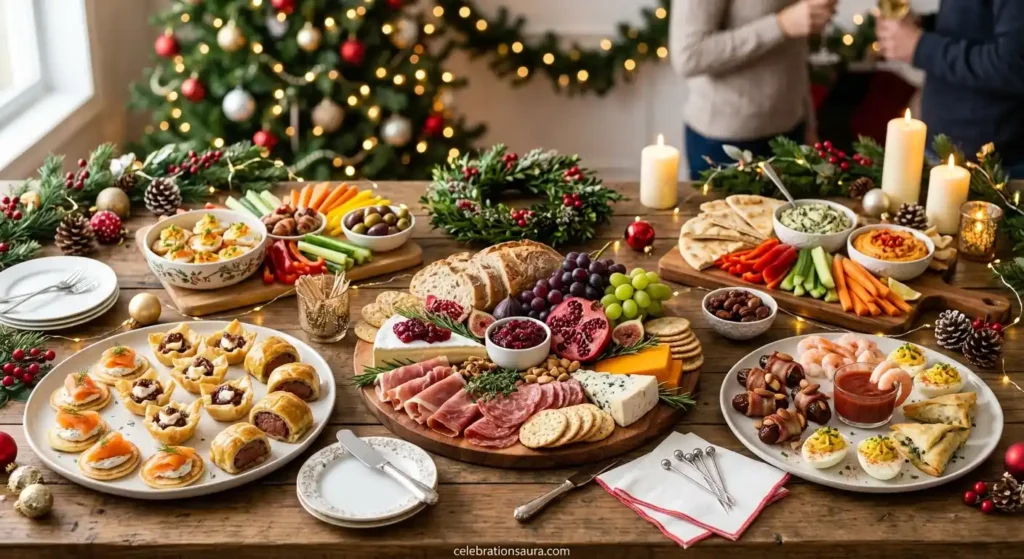
Guests often arrive hungry, but they may not sit down for dinner immediately. A few well-chosen appetizers give everyone something to eat while you finish the main course.
Aim for one creamy option, one savory or meaty option, one fresh option, and one crunchy snack. For 10 guests, about 30–40 bite-size appetizer portions gives you a comfortable starting point when dinner follows within an hour.
Good choices include baked Brie, stuffed mushrooms, deviled eggs, cranberry-and-cheese bites, spiced nuts, vegetable cups, and a simple cheese board. Current holiday entertaining roundups heavily emphasize dips, spreads, finger foods, cheese boards, and make-ahead bites because they work well for groups.
Make a Christmas Cheese Board That Feels Special
A cheese board can become your easiest centerpiece because almost everything can be arranged before guests arrive.
For 8–10 people, use three cheeses with different textures, one cured meat, two fruits, crackers, nuts, and one sweet element. A $30–$45 board can look generous when you use grapes, apples, cranberry jam, rosemary, and a few seasonal decorations around the edges.
Keep the cheese refrigerated until roughly 30–60 minutes before serving. That short tempering period helps the flavors become more noticeable without leaving the food sitting out for hours.
Try a Festive Christmas Tree Appetizer Board
Turn ordinary snacks into a Christmas centerpiece by arranging green grapes, vegetables, herbs, cheese cubes, or crackers in a triangular tree shape.
A large board can serve 10–15 people for roughly $25–$40 depending on the ingredients. Add a star-shaped cheese piece at the top and use red peppers, tomatoes, cranberries, or strawberries as edible “ornaments.”
This approach works particularly well for families because children can help arrange the ingredients. It also gives you a decorative centerpiece without buying another table decoration.
Add a Christmas Fruit Tray
Fresh fruit gives a heavy holiday table some color and acidity. A red-and-green combination of strawberries, grapes, kiwi, pomegranate, and citrus instantly looks seasonal.
For 10–12 guests, a $15–$25 fruit tray can be enough when it accompanies other desserts and appetizers. For 20 or more people, use two platters and about 3–4 pounds of mixed fruit rather than creating one crowded tray.
You can follow our full guide to Christmas fruit tray ideas for wreaths, trees, kid-friendly arrangements, dips, budget options, and make-ahead presentation tricks.
Set Up a Christmas Cookie Decorating Station
Cookie decorating can double as dessert and entertainment. Instead of decorating every cookie yourself, let guests create their own during the gathering.
For 8–10 people, prepare around 24–30 baked sugar cookies, three or four icing colors, sprinkles, candies, and disposable piping bags. Keep the decorating station on a washable table or tray so cleanup stays manageable.
For beginners, simple shapes usually work better than complicated designs. Current cookie-decorating coverage continues to favor easy techniques, store-bought decorations, simple icing patterns, and designs that children can actually complete.
For a complete collection of designs, link this section to Christmas cookie decorating ideas, especially if readers want beginner designs, royal icing techniques, or more creative 2026 styles.
Serve Easy Christmas Treats When Time Is Short
Not every Christmas dessert needs an oven. Chocolate-dipped pretzels, peppermint bark, Oreo truffles, decorated marshmallows, popcorn mixes, and Rice Krispie treats can create a festive dessert table without complicated baking.
Most simple treats can be prepared in about 10–30 minutes, making them especially useful for school parties, cookie exchanges, movie nights, and last-minute guests.
Our easy Christmas treats guide can take readers deeper into quick recipes, kid-friendly treats, edible gifts, and large-batch desserts.
Create a Dessert Table Instead of One Big Cake
A dessert table gives guests choices and reduces pressure on you to produce one perfect centerpiece dessert.
For 12 guests, try one larger dessert plus three smaller options. For example, serve a chocolate cake, peppermint bark, gingerbread cookies, and fruit. This creates different textures and flavors without requiring four complicated recipes.
Use cake stands, small bowls, and trays to create three levels of height. Even inexpensive serving pieces can make a $20 dessert spread look much more intentional.
Make a Christmas Hot Chocolate Bar
A hot chocolate station works especially well for family parties and evening gatherings. Prepare a large batch of hot chocolate and offer toppings separately.
For 10 guests, provide approximately 10–12 cups of hot chocolate, plus mini marshmallows, whipped cream, crushed peppermint, chocolate shavings, caramel sauce, and cinnamon.
Keep the toppings in small bowls and use mugs rather than disposable cups when possible. The setup becomes an activity instead of simply another drink on the table.
Create a Simple Christmas Drink Station
A drink station keeps guests from repeatedly asking the host for refills. Offer one signature drink, one nonalcoholic option, water, and coffee or tea.
For a group of 15, prepare roughly 20 servings of the main drink if the gathering lasts two to three hours. A cranberry-orange punch, sparkling apple cider, or rosemary lemonade can provide the festive color without requiring a bartender.
For adult gatherings, guests can add alcohol separately if appropriate. Keeping the base drink nonalcoholic also makes the station easier for mixed-age celebrations.
Choose the Right Christmas Dinner Main Dish
The main dish should match your guest count and cooking confidence, not simply what looks impressive in a recipe photo.
Ham works well for a large family because it serves many people and reheats easily. Turkey suits a traditional feast but requires more planning. Prime rib or beef tenderloin creates a more formal experience but usually costs considerably more.
For 6–8 guests, one main dish is enough. Avoid cooking two large proteins unless you know your guests expect both.
Build Sides Around the Main Dish
A balanced Christmas dinner usually needs a mixture of rich, fresh, creamy, and crisp elements.
If your main dish is rich, add a bright salad or roasted vegetables. If you serve a heavy potato dish, choose a lighter green vegetable rather than another creamy side.
For 10 guests, three substantial sides are usually enough. Good combinations include roasted potatoes, green beans, and a cranberry salad, or mashed potatoes, roasted carrots, and Brussels sprouts.
Current Christmas dinner coverage also emphasizes choosing the main dish first and then building sides around it rather than trying to cook every traditional dish at once.
Add One Fresh Dish to Balance Rich Holiday Food
A crisp salad or fresh vegetable dish can prevent the table from feeling overwhelmingly heavy.
Try mixed greens with pomegranate seeds, sliced pear, toasted pecans, and a simple vinaigrette. For 10 people, prepare about 10–12 cups of greens and keep the dressing separate until serving.
A fresh dish also gives vegetarian guests something substantial to enjoy alongside the traditional sides.
Plan a Christmas Brunch Instead of Dinner
Christmas brunch can be easier than a full dinner, particularly for families who spend Christmas afternoon traveling or visiting relatives.
Build the meal around one egg dish, one carb, fresh fruit, a sweet option, and drinks. A baked French toast, egg casserole, fruit platter, muffins, and coffee can serve 8–10 people without requiring several pans on the stove.
Brunch also lets you prepare much of the meal the night before, which frees up Christmas morning.
Use a Christmas Grazing Table for Casual Entertaining
A grazing table is ideal when guests will arrive at different times. Instead of serving a formal meal at one moment, create a spread that remains useful for two or three hours.
Combine cheeses, cured meats, crackers, fruit, vegetables, dips, nuts, and small sweets. Keep perishable foods replenished in smaller batches rather than placing the entire supply on the table.
For 15 guests, start with two or three cheeses, two meats, 2–3 pounds of fruit and vegetables, two dips, and several boxes of crackers or bread.
Christmas Food & Entertaining on a Budget
You do not need a $500 grocery bill to make a Christmas gathering feel generous.
For a budget-conscious dinner, spend more on one centerpiece item and save on sides, drinks, and dessert. Potatoes, carrots, cabbage, pasta, seasonal fruit, popcorn, and homemade cookies can stretch a menu considerably.
A simple 8-person meal might prioritize a $30–$50 main dish, $20–$30 of sides, $10–$15 of dessert ingredients, and $10–$20 for drinks. Prices vary by location and ingredients, so treat those figures as planning ranges rather than fixed costs.
Mid-Range Christmas Entertaining
A mid-range gathering gives you room for a more impressive appetizer table and better presentation.
For 10–12 guests, a $100–$175 food budget can support a main dish, three sides, appetizers, fruit, dessert, and nonalcoholic drinks, depending heavily on local grocery prices and the protein you choose.
Spend selectively. One beautiful cheese board or decorated dessert usually makes more visual impact than upgrading every single dish.
When Is Christmas Dinner Catering Worth It?
Christmas dinner catering becomes attractive when cooking competes with the reason you are hosting.
It makes particular sense for large groups, hosts with limited kitchen space, office celebrations, or families who would rather spend Christmas Day together than manage several hours of cooking.
Catering can range from simple drop-off meals to fully staffed events. Some current 2026 catering examples show substantial variation in pricing, with drop-off and full-service options priced very differently depending on location and service level.
For practical planning, explore Christmas dinner catering for menu formats, guest-count ideas, budgeting, and questions to ask before booking.
Compare Homemade, Hybrid, and Catered Christmas Food
| Approach | Best For | Time Needed | Budget |
|---|---|---|---|
| Homemade | Small family dinner | 4–8 hours | $ |
| Hybrid | Busy hosts | 2–4 hours | $$ |
| Catering | Large or formal events | 1–2 hours of setup | $$$ |
The hybrid option is often the sweet spot. Buy the dessert, order the main dish, and make two memorable sides yourself. Guests still get homemade food, but you remove the most stressful parts of the menu.
How Do You Find Christmas Dinner Near Me?
Search for Christmas dinner near me when you want a restaurant meal, prepared holiday package, pickup option, or local delivery rather than cooking everything yourself.
Start looking several weeks ahead, then check the restaurant’s holiday menu, reservation requirements, pickup times, delivery area, serving size, and cancellation policy. Christmas Day availability can disappear quickly, particularly for popular restaurants.
If you want a local meal, search both restaurants and grocery stores because some supermarkets offer prepared holiday dinners alongside traditional restaurant options.
When Should You Start Planning Christmas Food?
Start the basic plan at least three to four weeks before Christmas if you are hosting more than 10 people.
Two weeks out, finalize the menu and guest count. One week out, buy shelf-stable ingredients and make freezer-friendly treats. One or two days before Christmas, prepare desserts, sauces, chopped vegetables, and other dishes that hold well.
Make-ahead planning is a recurring theme in successful holiday entertaining because it moves work away from the busiest day.
What Christmas Food Can You Make Ahead?
Cookies, brownies, bark, some cakes, dips, sauces, casseroles, and certain roasted vegetables can often be prepared before the event.
For example, bake cookies several days ahead and store them airtight. Prepare a cheese board’s components the day before but assemble it closer to serving. Make dips 24 hours ahead when their flavors benefit from chilling.
The goal is not to make everything early. The goal is to identify which jobs actually improve or remain stable after preparation.
Plan Christmas Food for Kids
Children usually need simpler choices than adults, particularly at long holiday dinners.
Include familiar foods such as fruit, rolls, chicken pieces, pasta, potatoes, cookies, or decorated treats. A small kid-friendly station can prevent children from repeatedly leaving the table because nothing looks familiar.
Cookie decorating also works well as an activity. Give children pre-baked cookies, washable decorating mats, and three or four toppings rather than an overwhelming selection of 15 ingredients.
Make Christmas Entertaining Easier for Older Guests
Food should be easy to see, reach, and eat. Avoid placing every dish at one end of a crowded table.
Use lightweight serving dishes, clearly label unusual ingredients, and keep seating close to the buffet if guests have mobility limitations. Softer foods and easy-to-handle appetizers can also make the meal more comfortable.
Small practical changes often make a larger difference than expensive decorations.
Include Vegetarian and Dietary-Friendly Options
You do not need a completely separate menu for every dietary preference. Instead, build at least one substantial option around vegetables, grains, beans, or cheese.
A vegetarian stuffed squash, mushroom Wellington, roasted vegetable platter, or hearty salad can become a real main dish rather than an afterthought.
Also label common allergens when serving food buffet-style. Nuts, dairy, eggs, gluten, and shellfish can appear in several dishes without guests immediately realizing it.
Turn Christmas Food Into Edible Gifts
Some holiday foods work just as well as gifts as they do on the dessert table.
Peppermint bark, decorated cookies, fudge, biscotti, spiced nuts, and popcorn mixes package easily in tins, jars, cellophane bags, or small boxes.
For a $10–$20 homemade food gift, combine two or three sturdy treats in a reusable container and add a handwritten tag. Make sure the recipient knows about major allergens when relevant.
Common Christmas Food Hosting Mistakes to Avoid
The biggest mistake is cooking too many dishes that require last-minute attention.
Another common problem is preparing only rich foods. If every appetizer contains cheese, cream, pastry, or meat, guests quickly need something fresh.
Finally, do not underestimate serving equipment. Before Christmas Day, check that you have enough plates, forks, serving spoons, glasses, napkins, storage containers, and refrigerator space for leftovers.
What Is the Best Christmas Food Strategy for a Large Group?
For 20 or more guests, buffet-style service usually works better than plated dinner because guests can serve themselves and you avoid timing every plate.
Choose one main dish, three or four sides, two appetizers, a fresh fruit or salad option, and two desserts. Prepare at least half the menu one day early.
If your kitchen cannot handle the volume, combine homemade sides with prepared mains or use Christmas dinner near me as a starting point for finding local pickup and dining options.
What Should You Serve for a Last-Minute Christmas Gathering?
Choose foods that require little cooking and can be assembled quickly. A cheese board, fruit tray, store-bought cookies with festive decorations, warm dip, sparkling cider, and one easy main dish can create a complete spread in about 60–90 minutes.
Do not attempt a complicated roast or multi-course menu when you have only a few hours. Simple food served warmly and attractively usually beats an ambitious menu served under stress.
Final Thoughts
Christmas food & entertaining should make the holiday feel fuller, not make the host disappear into the kitchen. Start with the people you are feeding, choose a realistic menu, and give yourself permission to mix homemade dishes with store-bought or catered food.
A colorful fruit tray, warm appetizer, beautifully decorated cookies, and one memorable main dish can create a table guests remember long after the plates are cleared. If you are hosting a large group, make-ahead dishes and catering can protect your time, while smaller gatherings can lean into personal touches and family traditions.
Most importantly, leave some space in the schedule to sit down, laugh, and actually enjoy the meal you planned. Pick one idea from this guide, make it your own, and start planning a Christmas gathering that feels genuinely yours.
FAQs
What food is traditionally eaten at Christmas?
Traditional Christmas food varies by family and region, but common American holiday meals include ham, turkey, roast beef, mashed potatoes, vegetables, rolls, cookies, pies, and other festive desserts. Family traditions often matter more than following one fixed menu.
How much food do I need for 10 people at Christmas?
For 10 guests, plan one main dish, three sides, two or three appetizers, one dessert, and enough drinks for the length of the gathering. Increase appetizer and side portions when dinner will be delayed by more than an hour.
What can I make the day before Christmas?
You can make many cookies, brownies, desserts, dips, sauces, casseroles, and some side dishes the day before. Prepare ingredients for fresh dishes ahead, but assemble delicate salads, fruit trays, and crisp foods closer to serving.
Is it cheaper to cater Christmas dinner or cook at home?
Cooking at home is usually cheaper when you have the time, equipment, and a manageable guest count. Catering can become worthwhile when you value convenience, need to feed a large group, or would otherwise need to buy extra equipment and spend most of Christmas Day cooking.
How do I make Christmas dinner less stressful?
Limit the menu to dishes that serve a clear purpose, prepare as much as possible ahead, and choose only one or two items that need last-minute cooking. A hybrid menu that combines homemade dishes with prepared food can dramatically reduce workload.
Discover More
Womens Christmas Outfit: 18+Festive Ideas for 2026
Christmas Party Decorations: 25 Creative Ideas for a Festive Celebration
